
- 27/10/2026
- Clairevision Eye Hospital
- 0 Comments
- Blogs
Can Keratoconus Get Worse Over Time? Understanding Its Progression
You change your glasses, and within a few months the vision turns blurry again. Lights start to streak, and night driving becomes stressful. If this sounds familiar, the cause could be keratoconus, a condition where the clear front surface of the eye slowly changes shape.
The biggest worry patients share is, “Will it keep getting worse?” Understanding keratoconus progression is the first step to protecting your eyesight. According to Dr. Archana Singh, who has 19 years of experience at Clairevision Eye Hospital, many patients searching for keratoconus treatment in Pune come in late, simply because they thought their blurry vision was a normal power change. So, does keratoconus get worse? The short answer is that it can, but with timely care, it can often be controlled. Let’s understand how.
What Is Keratoconus?
So, what is keratoconus? The cornea is the clear, dome-shaped layer at the front of your eye, and it helps focus light. In keratoconus, this layer becomes thin and weak, so it bulges outward into a cone-like shape. This irregular shape scatters light and distorts vision.
It usually starts in the teenage years or the early twenties. Common keratoconus symptoms include:
- Blurred or double vision
- Frequent changes in glasses number
- Sensitivity to light and glare
- Halos or streaks around lights
Keratoconus causes are not completely understood. Genetics, constant eye rubbing, and allergies are believed to play a role.
Does Keratoconus Always Get Worse?
Not always. Many people want to know if keratoconus can get worse, and the honest answer is that it depends on the person. In some patients, the condition stays mild for years. In others, it moves ahead quickly.
How fast does keratoconus progress? There is no fixed timeline. The keratoconus progression rate is generally faster in teenagers and young adults. After the age of 30 to 40, the cornea often stabilises on its own. That is why regular check-ups matter, since only an eye examination can tell whether your condition is stable or changing.
Stages of Keratoconus Progression:
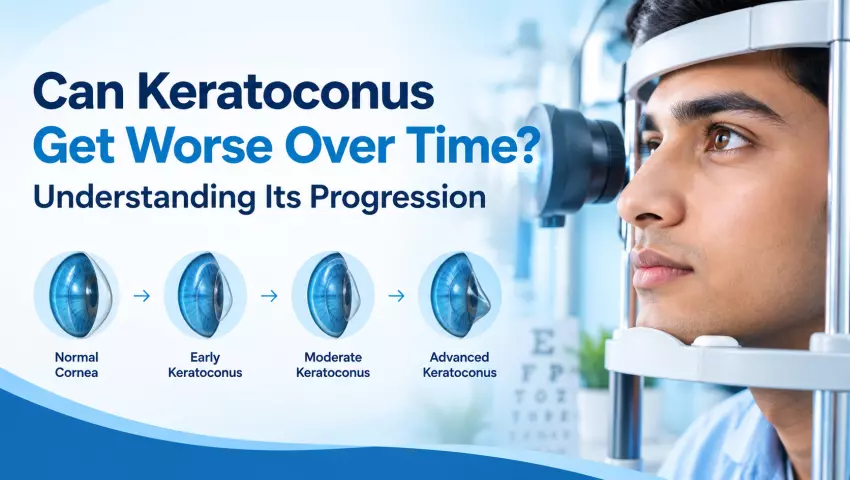
Doctors usually describe the stages of keratoconus in four steps:
- Early stage: Slight blurring and mild astigmatism. Glasses still help.
- Moderate stage: Vision distortion increases, and the glasses number keeps changing. Ghost images may appear.
- Advanced stage: The cornea becomes noticeably thin. Glasses no longer give clear vision, and special lenses are needed.
- Severe stage: Corneal scarring may develop, and vision drops significantly.
Sometimes, in advanced cases, the cornea can suddenly swell and turn hazy, which is called hydrops. This causes pain and a sudden fall in vision, so you should see a doctor immediately. These keratoconus stages are not the same for everyone, and some people never reach the later ones. Early detection is the best protection against keratoconus worsening.
Factors That Affect How Fast Keratoconus Progresses:
Several things decide how quickly the condition moves:
- Age: Younger patients usually face faster progression.
- Eye rubbing: This is the most common and most avoidable trigger. Rubbing weakens the already thin cornea.
- Allergies: Itchy eyes lead to more rubbing, which adds to the damage.
- Family history: If a close relative has keratoconus, your risk is higher.
- Hormonal changes: Puberty and pregnancy have been linked to faster changes in some people.
The good news is that some of these, especially rubbing and allergies, are in your control.
Warning Signs Your Keratoconus Is Getting Worse:
Do not ignore these signals:
- Your glasses number changes every few months
- Vision is not clear even with new glasses
- Your keratoconus contact lenses feel loose, uncomfortable, or no longer give sharp vision
- Night glare and light sensitivity are increasing
- Objects look stretched or doubled
- Sudden pain, redness, or a quick drop in vision
If you notice two or more of these, book an appointment with a trusted eye specialist in Pune without delay. A simple corneal scan can show whether the shape of your eye is changing.
Treatments That Can Stop or Slow Progression:
The most important treatment to halt the condition is corneal cross-linking. It is also called keratoconus cross-linking or corneal collagen cross-linking. In this procedure, riboflavin (vitamin B2) drops are applied to the cornea and activated with controlled UV light. This strengthens the corneal fibres and helps stop the cone from growing. It is best done early, before the vision has been badly affected.
Other options help improve vision at different stages:
- Glasses: Useful only in the early stage.
- Special lenses: Rigid gas permeable lenses and scleral lenses for keratoconus give much clearer vision by creating a smooth surface over the uneven cornea.
- Intracorneal ring segments: Small implants that help flatten the cone.
- Keratoconus surgery: A corneal transplant is considered only in very advanced cases where other options do not work.
If you are looking for keratoconus treatment in Pune, choose a centre that offers proper corneal scans, cross-linking, and specialty lens fitting under one roof. At Clairevision Eye Hospital, Dr. Archana Singh creates a treatment plan based on the stage of your condition, so you receive only what you actually need. For many families, this makes it one of the best eye hospitals in Wakad for advanced corneal care.
Can You Prevent Keratoconus From Getting Worse?
You cannot always prevent keratoconus, but you can certainly reduce the chances of it worsening. Here is how to slow down keratoconus:
- Stop rubbing your eyes. Even gentle, frequent rubbing can harm a weak cornea.
- Treat allergies early. Use eye drops only as advised by your doctor.
- Manage dry eyes. Lubricating drops can reduce the urge to rub.
- Wear UV-protective sunglasses when outdoors.
- Never skip follow-ups. Regular corneal scans catch changes before you feel them.
- Ask about cross-linking if your doctor finds that the condition is progressing.
Small habits make a big difference over the years.
When to See an Eye Doctor?
Do not wait until your vision becomes very poor. See a doctor if your glasses number keeps changing, if you have been told you have astigmatism that does not settle with glasses, or if keratoconus runs in your family. Children and teenagers who rub their eyes often should also be examined.
A cornea specialist can detect keratoconus early through a painless scan. If you are searching for the best eye hospital in Wakad, Clairevision Eye Hospital offers detailed evaluation and personalized care. Whether you need a second opinion or a complete treatment plan, an early check-up can protect your vision for the long term.
Conclusion:
So, can keratoconus get worse over time? Yes, it can, especially in younger people. But it does not have to lead to severe vision loss. Knowing how to stop keratoconus progression is simple: avoid eye rubbing, control allergies, go for regular check-ups, and take timely treatment when advised.
Modern keratoconus treatment, from cross-linking to specialty lenses, has helped thousands of people keep good, usable vision. Early diagnosis is the key. If you or your loved one has been facing blurry or changing vision, do not delay. Book a consultation with Dr. Archana Singh at Clairevision Eye Hospital in Wakad, Pune, and take the first step toward clearer, safer vision.