
- 21/11/2026
- Clairevision Eye Hospital
- 0 Comments
- Blogs
What Is Corneal Topography and Why Is It Important Before Eye Surgery?
Imagine you have planned LASIK for months, only to find out after surgery that your cornea was never suitable for it. Sadly, this can happen when the cornea is not studied properly beforehand. The good news is that it is easily avoidable with one simple, painless test called corneal topography.
At Clairevision Eye Hospital, patients looking for cornea treatment in Wakad are often surprised by how much a 5-minute scan can reveal. According to Dr. Archana Singh, an experienced Eye Specialist in Pune with 19 years of practice, this test is the foundation of safe vision correction.
In this blog, we explain what corneal topography is, how it works and why no responsible surgeon skips it before eye surgery.
What Is Corneal Topography?
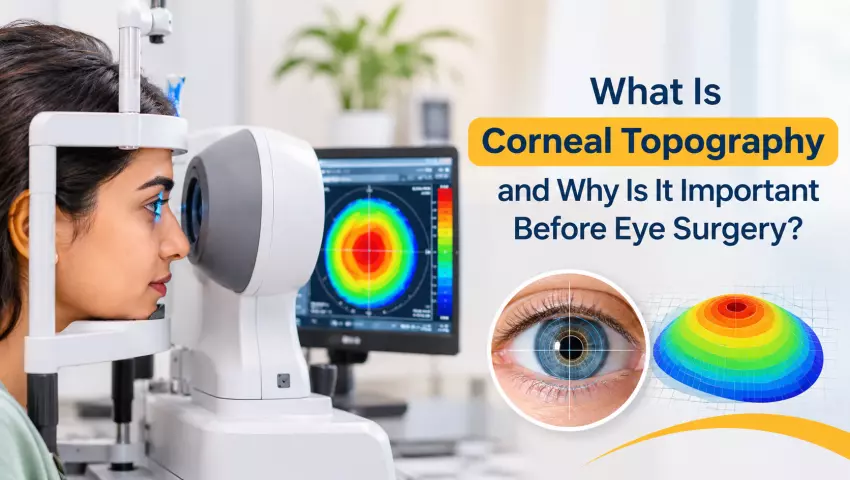
Corneal topography is a corneal imaging test that creates a detailed 3D map of the front surface of your eye. Think of it like a contour map of a hill, showing every slope, curve and dip.
The cornea is the clear, dome-shaped layer at the front of your eye. It does about two-thirds of the eye’s focusing work. If its shape is even slightly uneven, your vision can become blurry or distorted. This is why corneal mapping is considered a key part of any eye test before LASIK surgery.
How Does a Corneal Topography Test Work?
The test is quick, comfortable and does not involve any touching of the eye.
- You sit in front of a machine and rest your chin on a support.
- You look at a fixed light or a pattern of rings.
- The device captures images of how light reflects off your cornea.
- Software converts these images into a colour-coded map.
The whole corneal scan takes only a few minutes. Cooler colours (blue and green) usually show flatter areas, while warmer colours (orange and red) show steeper areas. Your doctor reads these patterns to understand your corneal curvature and spot any problem. Advanced machines also measure corneal thickness at the same time.
You may be asked to stop wearing contact lenses for some days before the test, as lenses can temporarily change the shape of the cornea.
Why Is Corneal Topography Important Before Eye Surgery?
Eye surgery, especially laser vision correction, works by reshaping the cornea. So the surgeon must know exactly what shape the cornea has before making any plan. Here is what the test tells us.
- Evaluating the Shape and Curvature of the Cornea: A healthy cornea has a smooth and regular curve. The corneal curvature test shows whether your cornea is too steep, too flat or uneven. This information decides how much tissue needs to be reshaped and in which pattern.
- Identifying Irregular Corneal Surfaces: Many people have mild surface irregularities without any symptoms. Such corneal surface irregularities can come from old eye injuries, dry eyes, scarring or long-term contact lens use. If they are not detected, they can affect the final surgical result.
- Checking Corneal Thickness and Related Abnormalities: LASIK removes a small amount of corneal tissue, so enough thickness must remain for the eye to stay strong. Topography helps identify thin corneas and other corneal abnormalities that need extra caution.
- Determining Whether the Cornea Is Suitable for Surgery: Not every eye is suited to LASIK. Corneal topography is a main part of the LASIK eligibility test. Depending on the results, your doctor may confirm LASIK, suggest another procedure such as PRK or ICL, or advise no surgery at all.
- Identifying Potential Risks Before Surgery: The scan shows early warning signs of conditions that make surgery risky. Finding them in advance protects your vision and lets the surgeon choose the safest option for you.
How Does Corneal Topography Help Prevent Complications After Eye Surgery?
A proper preoperative eye evaluation reduces the chances of problems after surgery. Here is how topography helps:
- Safer patient selection: Unsuitable eyes are identified before surgery, not after.
- Personalised planning: The treatment is customised to your cornea, not a general pattern.
- Lower risk of corneal weakening: Thin or weak corneas are flagged early.
- Better visual quality: Treating an irregular cornea without a map can cause glare, halos or night vision problems.
In simple words, the test turns surgery from a guess into a plan. Patients who go through careful screening at a trusted centre generally enjoy more predictable results and a smoother recovery.
Can Corneal Topography Detect Keratoconus Before Eye Surgery?
Yes, and this is one of its most valuable uses. Keratoconus is a condition in which the cornea gradually becomes thin and bulges outward in a cone-like shape. It often begins in the teenage years or early twenties, and in the early stage it may cause only mild blurring or frequent changes in glasses power.
Regular eye tests may miss early keratoconus, but corneal topography for keratoconus can catch it clearly. The map shows steep areas, uneven curvature and signs of corneal thinning long before symptoms become obvious.
This matters because LASIK on a keratoconic cornea can make the cornea weaker and worsen the condition. With early keratoconus detection, doctors can instead advise treatments like corneal cross-linking to stabilise the eye. If you or your child needs cornea treatment in Wakad for keratoconus, an early scan makes the treatment simpler and more effective.
Why Is Corneal Mapping Important Before Contoura Vision and Other Refractive Surgeries?
Contoura Vision is a topography-guided LASIK procedure. Unlike standard LASIK, it uses the unique corneal map of each eye to correct not just your power but also the natural irregularities of your cornea, giving sharper and higher-quality vision.
Here, corneal mapping is not just a screening step. It is the very basis of the treatment, as the laser follows the topography data from the scan. This is why a centre among the Best Eye Hospital in Wakad options invests in advanced diagnostic machines and trained staff to capture reliable scans.
The same applies to other refractive surgery screening, such as PRK, SMILE and implantable lens procedures, which all need accurate information about corneal shape, thickness and health.
What Happens If Corneal Topography Is Not Performed Before Eye Surgery?
Operating without a corneal map is like driving in an unfamiliar city without navigation. You may reach your destination, but the risk of going wrong is high. Without topography:
- Early keratoconus can go unnoticed.
- A thin cornea may be treated too aggressively.
- Irregular astigmatism may stay uncorrected.
- The result may be poor vision quality, glare, haloes or the need for repeat procedures.
- In rare cases, the cornea may become unstable after surgery (corneal ectasia).
These problems are largely preventable, which is why a complete corneal evaluation before eye surgery is considered a basic standard of care and not an optional extra.
Is Corneal Topography Necessary Before Every Eye Surgery?
Not for every surgery, but for many. It is considered essential before:
- LASIK, PRK, SMILE and Contoura Vision
- Implantable lens (ICL) procedures
- Corneal transplant or cross-linking
- Cataract surgery in certain cases, especially when a premium lens is planned or the patient has astigmatism
In cataract surgery, corneal shape affects the choice and power of the lens implant. Even if your surgery does not directly involve the cornea, your doctor may still advise this scan if you have a history of eye injury, previous surgery or unusual vision changes. When unsure, simply ask your Eye Specialist in Pune whether the test is required in your case.
What Happens After a Corneal Topography Test?
Once the scan is done, you can return to your routine immediately, as there is no downtime. The doctor studies the colour maps along with other test results such as eye power, pupil size, dry eye assessment and retina check.
Usually, one of three outcomes follows:
- Your cornea is healthy and suitable: You may proceed with the planned surgery.
- Borderline findings: The doctor may repeat the scan or advise further tests to confirm.
- Abnormality detected: An alternative surgery or a treatment to protect the cornea is recommended.
Whatever the result, the biggest benefit is clarity. You make your decision with complete information and confidence.
Conclusion:
Corneal topography is a quick and painless test, yet it gives surgeons one of the most important sets of information for planning eye surgery. It shows the shape, curvature and thickness of your cornea, catches problems like keratoconus early and helps choose the safest procedure for your eyes. Whether you are considering LASIK, Contoura Vision or any other vision correction, never skip this step.
If you are planning surgery or simply want your eyes checked, a consultation with an experienced Eye Specialist in Pune can give you the right direction. At Clairevision Eye Hospital, Dr. Archana Singh and her team use advanced diagnostic technology and a patient-first approach, which is why many people consider it the Best Eye Hospital in Wakad for comprehensive cornea treatment in Wakad and nearby areas.
Book your corneal evaluation today and take the first safe step towards clear vision.