
- 12/08/2026
- Clairevision Eye Hospital
- 0 Comments
- Blogs
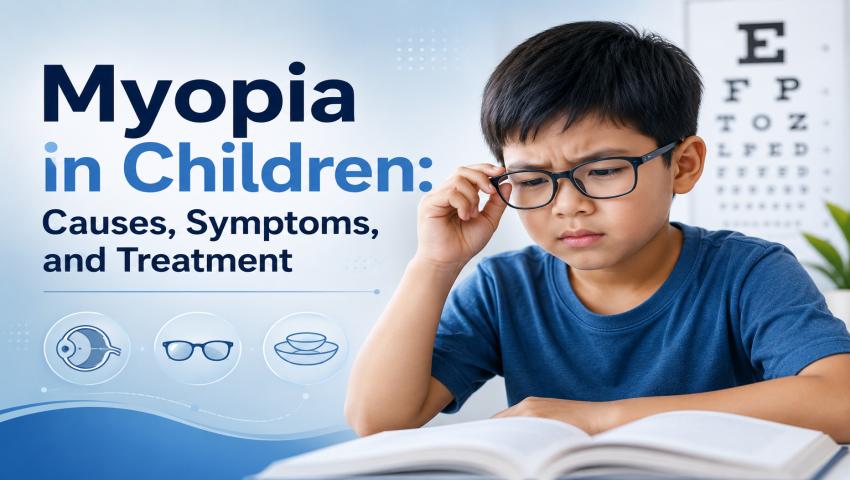
Myopia in Children: Causes, Symptoms, and Treatment
Does your child sit too close to the TV, squint while reading the blackboard, or complain of headaches after school? These small habits are often brushed off as “just a phase,” but they can actually be early signs of myopia in children. According to Dr. Archana Singh, a well-known Eye Specialist in Pune with 19 years of experience and founder of Clairevision Eye Hospital, cases of childhood myopia have risen sharply in the last decade, largely due to increased screen time and reduced outdoor play.
The good news is that with timely diagnosis and the right care, myopia in kids can be managed effectively, protecting their vision for years to come. In this blog, we will walk you through everything parents need to know, from causes to treatment.
What Is Myopia in Children?
Myopia, commonly known as nearsightedness, is a refractive error in which a child can see nearby objects clearly but struggles to focus on distant ones. This happens because the eyeball grows slightly longer than normal, or the cornea is too curved, causing light rays to focus in front of the retina instead of directly on it. As a result, objects far away, such as a whiteboard in class or a signboard on the road, appear blurry.
Nearsightedness in children usually begins between the ages of 6 and 14, a period when the eyes are still developing rapidly. If not managed early, it tends to worsen year after year, a condition doctors refer to as progressive myopia.
What Causes Myopia in Children?
Understanding the causes of myopia in children helps parents take preventive steps early on. Some of the most common contributing factors include:
- Genetics – If one or both parents are myopic, the child has a significantly higher chance of developing it too.
- Excessive near-work – Long hours spent reading, writing, or using mobile phones and tablets strain the eyes.
- Reduced outdoor exposure – Children who spend less time outdoors in natural light are more prone to developing refractive errors in children.
- Poor lighting conditions – Studying or reading in dim light forces the eyes to work harder.
- Excessive screen time – Continuous close-range focusing on digital screens is one of the biggest modern-day triggers.
Interestingly, this topic is even part of school science, where students study the causes of myopia class 10th syllabus, learning how the shape of the eyeball and lens power contribute to blurred distance vision. This just shows how common and well-recognised the condition has become among school-going children.
Signs and Symptoms of Myopia in Children:
Many parents miss the early symptoms of myopia because young children often don’t realise their vision is different from others. In fact, common nearsightedness symptoms are often mistaken for simple tiredness or lack of attention in class. Watch out for these warning signs:
- Frequent squinting while watching TV or looking at the board
- Sitting very close to screens or holding books too near the face
- Complaints of headaches or eye strain, especially after school
- Rubbing eyes often
- Difficulty recognising people or objects from a distance
- Poor performance in class due to trouble reading the blackboard
These nearsightedness symptoms can easily be mistaken for lack of concentration or tiredness, which is why regular eye check-ups matter. Since myopia symptoms in children often develop gradually, a child may adapt to blurry vision without complaining at all, making parental observation crucial.
How Myopia Affects a Child's Daily Life?
Untreated or poorly managed myopia can affect much more than just eyesight. It can influence:
- Academic performance – Difficulty reading from the board can lead to falling behind in studies.
- Sports and outdoor activities – Poor distance vision makes catching a ball or cycling safely harder.
- Confidence and social interaction – Children may feel left out or embarrassed about wearing glasses or struggling to see.
- Sleep and mood – Constant eye strain can cause fatigue, irritability, and headaches.
Recognising these child vision problems early ensures your child doesn’t have to compromise on learning, play, or confidence.
How Is Myopia Diagnosed in Children?
Diagnosis is simple and painless. During a comprehensive eye exam, the eye specialist typically checks:
- Visual acuity test – Using an eye chart to measure how clearly your child can see at a distance.
- Retinoscopy – To estimate the refractive error without needing the child’s active response.
- Dilated eye examination – Eye drops are used to relax the focusing muscles and get an accurate reading of the eye’s true refractive status.
- Axial length measurement – Especially useful in tracking myopia progression over time in growing children.
Dr. Archana Singh recommends that children get their first comprehensive eye check-up by age 4-5, and annually thereafter, especially if there is a family history of nearsightedness. Getting this done at a dedicated Pediatric Eye Care Clinic in Wakad ensures the tests are child-friendly and the results are interpreted with a child’s growing eyes in mind.
Treatment Options for Myopia in Children at Clairevision Eye Clinic:
There isn’t a permanent cure for myopia, but several effective options fall under myopia treatment for children, aimed at correcting vision and slowing progression:
- Prescription glasses – The most common and straightforward correction method for clear distance vision.
- Contact lenses – Suitable for older, responsible children who prefer not to wear glasses.
- Orthokeratology (Ortho-K lenses) – Special lenses worn overnight that reshape the cornea temporarily.
- Atropine eye drops – Low-dose drops that have shown promising results in slowing down myopia progression.
- Myopia control spectacle lenses – Specially designed lenses that reduce the rate at which myopia worsens.
The goal of modern myopia control strategies is not just to correct blurred distance vision but to actually slow the progression of the condition, reducing the risk of high myopia and related complications later in life.
Choosing the Best Eye Hospital in Wakad, Pune, for these treatments makes a real difference, as accurate monitoring and the right combination of lenses or drops require experienced hands.
What Happens If Childhood Myopia Is Left Untreated?
Ignoring myopia in children doesn’t just mean blurry vision continues, it can lead to more serious consequences over time:
- Rapid progression – Uncorrected eyes tend to strain more, accelerating worsening of vision.
- High myopia risk – Severe myopia in adulthood increases the risk of retinal detachment, glaucoma, and cataracts.
- Learning difficulties – Struggling to see the board can directly impact academic growth.
- Reduced quality of life – From sports to socialising, an untreated vision problem limits everyday activities.
This is why early intervention for progressive myopia is so important, addressing it in childhood can significantly reduce long-term eye health risks.
When Should You Consult an Eye Specialist Dr. Archana Singh?
You should book an appointment with an eye specialist if your child:
- Frequently squints or rubs their eyes
- Sits unusually close to the TV or holds books near their face
- Complains of headaches or blurred distance vision
- Shows a sudden drop in academic performance
- Has a family history of myopia
If you’re searching for a trusted Eye Specialist in Pune, Dr. Archana Singh at Clairevision Eye Hospital brings 19 years of experience in diagnosing and managing paediatric eye conditions. As a well-known Pediatric Eye Care Clinic in Wakad, Pune, the hospital offers comprehensive eye check-ups, myopia control treatments, and personalised care plans for growing children.
Conclusion:
Myopia in children is common, but it doesn’t have to hold your child back. A little attention to nearsightedness symptoms, a yearly eye check-up, and more time outdoors can keep their vision on track for the long run.
Need expert help? Clairevision Eye Hospital, led by Dr. Archana Singh, offers trusted myopia treatment for children you can rely on. Your child’s eyes deserve nothing less.
Frequently Asked Questions:
It depends on the child’s age and severity. Options include glasses, contact lenses, Ortho-K lenses, low-dose atropine drops, and myopia control spectacle lenses — Dr. Archana Singh recommends the right combination after a full eye exam.
No, but it can be managed effectively. Early diagnosis plus the right treatment plan can significantly slow its progression and protect long-term eye health.
Not once the eyeball has elongated. But Ortho-K lenses can temporarily reshape the cornea, and treatments like atropine drops can slow progression. Early detection makes the biggest difference.
Dr. Archana Singh recommends the first eye check-up at age 4–5, with annual exams after — especially if there’s a family history of myopia.
Low-dose atropine drops are among the most promising options for slowing progression, but an eye specialist needs to assess the child first.
There’s no natural cure, but outdoor play, good lighting, and breaks from screens (like the 20-20-20 rule) can help slow progression alongside professional treatment.